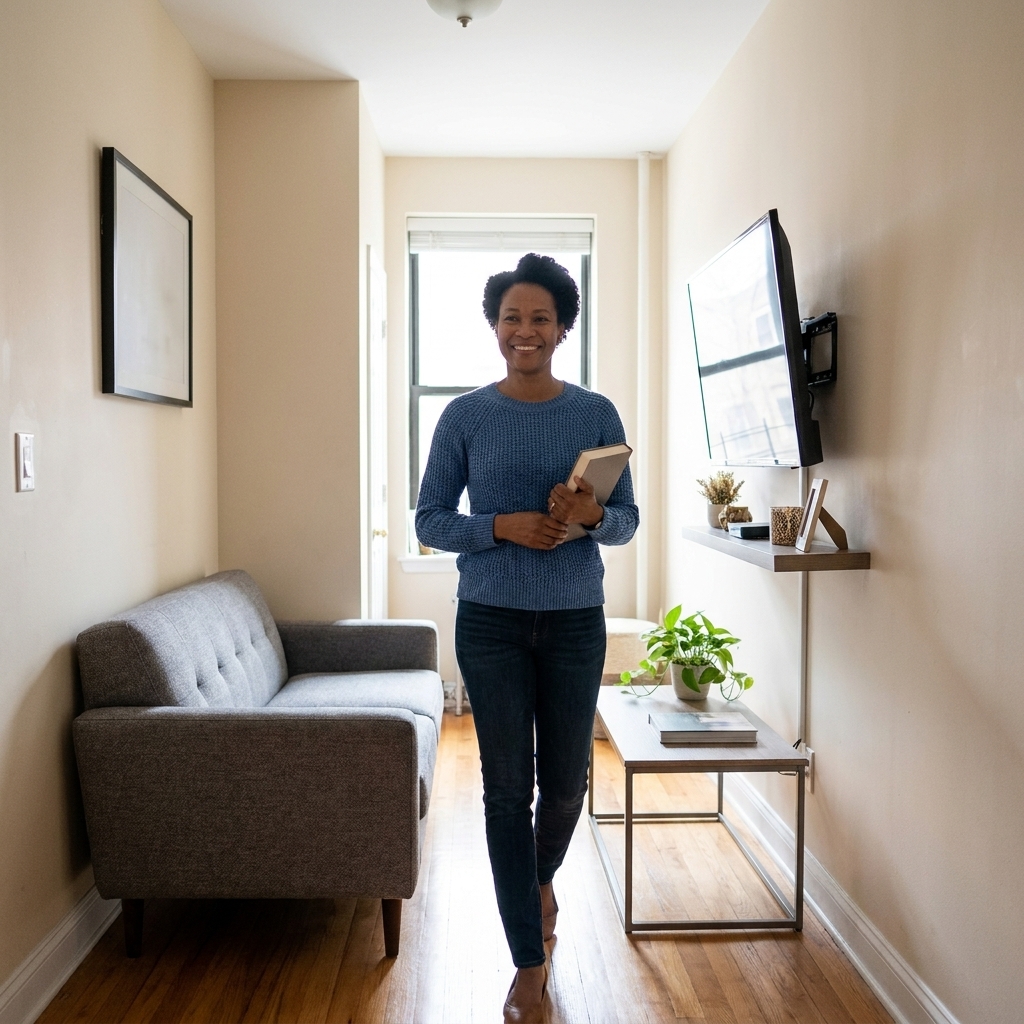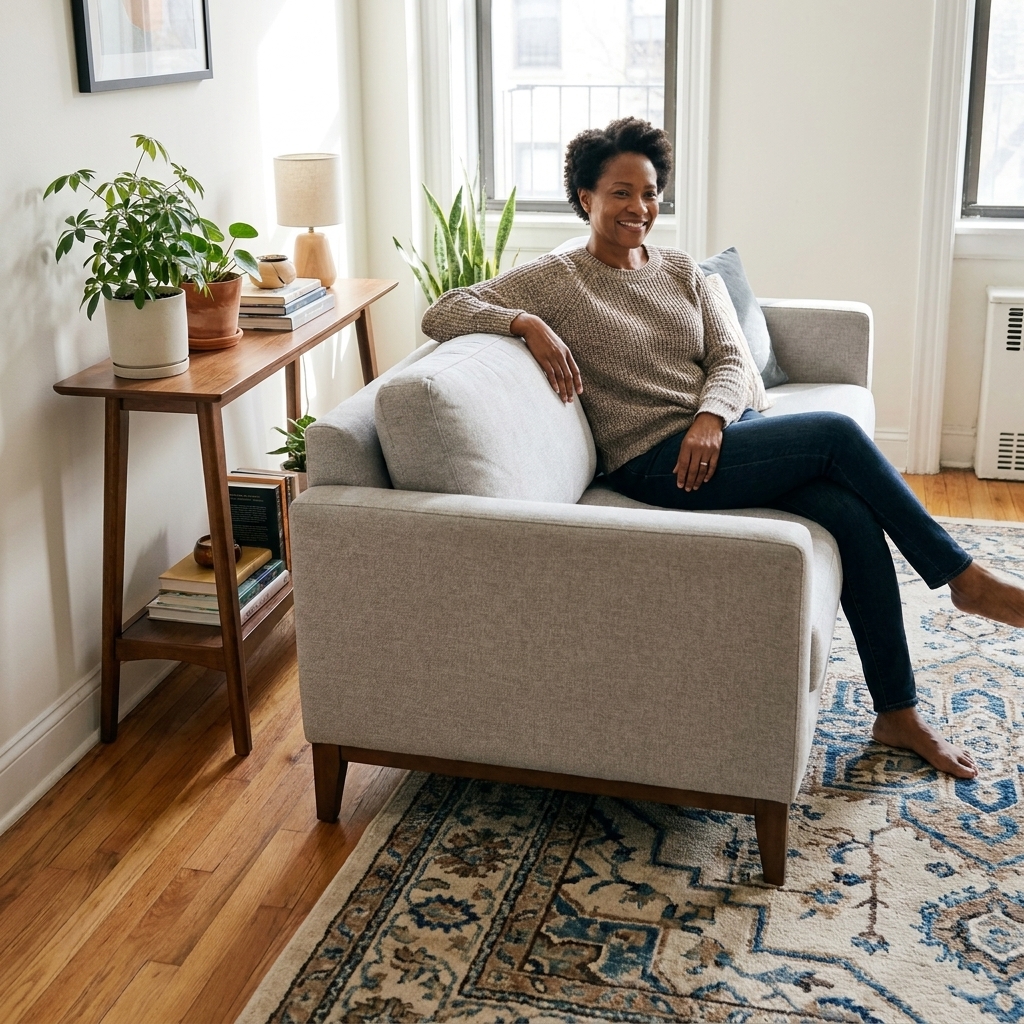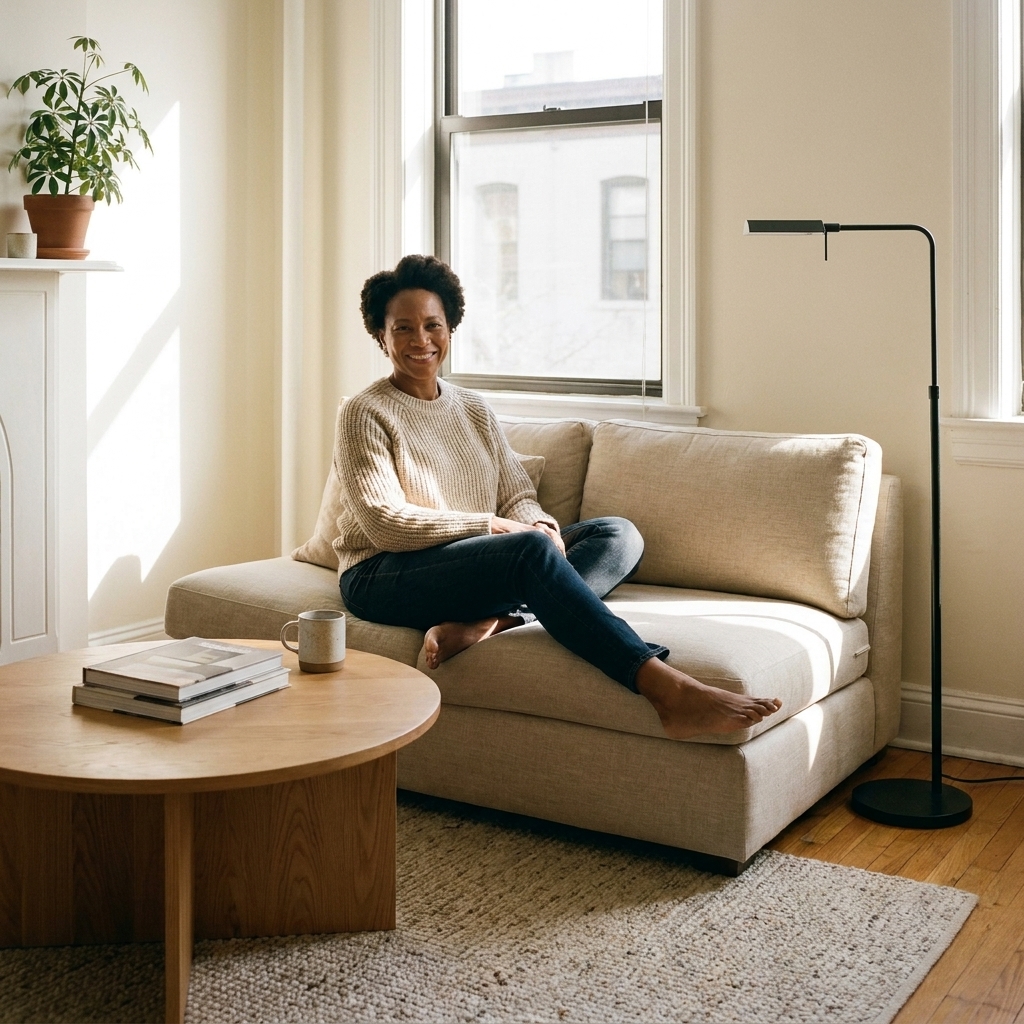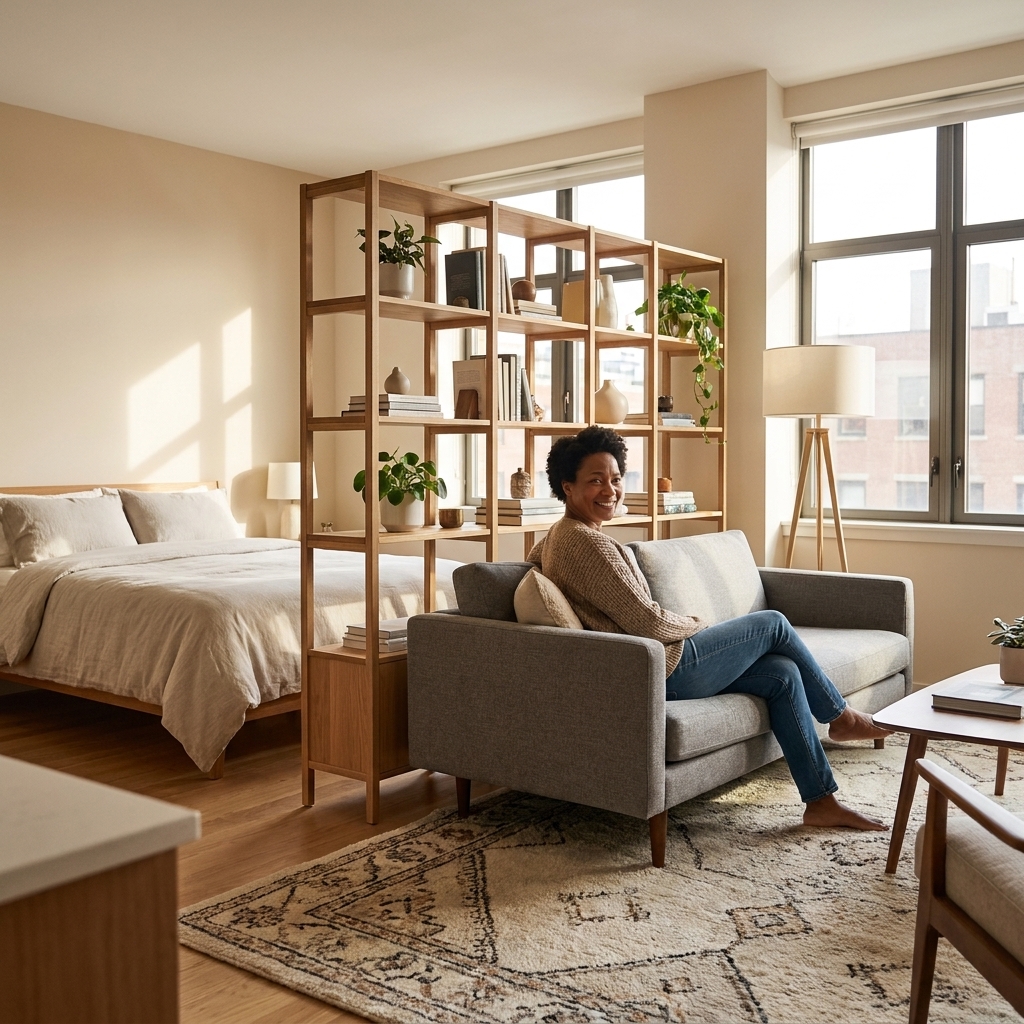
Create distinct zones in a one-room studio with renter-friendly dividers: rugs, curtains, shelving, and layout tricks that keep your space open and breathable.
Space Ovo
Small Room, Big Rug
A too-small rug can make a small room feel choppy. Here’s how to size and place a bigger area rug so your space looks wider, calmer, and pulled together.

Maya Brooks
Maya Brooks is an interior stylist and layout enthusiast who believes square footage should never dictate your home's style. After a decade of navigating cramped city studios, she shares practical, renter-friendly decorating and storage solutions to help others maximize their tiny spaces.
Created October 17, 2026
Updated October 17, 2026
I know it feels backwards: your living room is tiny, so you buy a tiny rug. Then you roll it out and suddenly everything looks… even tinier. Been there, measuring tape in hand, trying to convince myself a 5x7 was “plenty.”
The truth is, undersized rugs break up the floor into little islands, which makes your eye read the room as smaller. A larger rug often does the opposite. It creates one calm, continuous zone that visually stretches your floor plan. If you want a small space to feel more open, a bigger rug can be one of the most renter-friendly “renovations” you can make.
Why small rugs make a room feel smaller
Think of your floor like negative space in a great outfit. When you chop it into pieces, everything feels busier and tighter.
- They create visual clutter. A little rug floating in the middle of the room looks like a doormat that escaped. Your eye catches the rug edge, then the bare floor, then furniture legs, then another edge. Too many stops and starts.
- They shrink the zone. In a living room, the rug is the stage. If the stage is small, the whole seating area reads as small, even if the actual room is bigger.
- They make furniture look awkward. When only a coffee table fits on the rug (and nothing else does), the layout feels unanchored. Your brain reads it as less intentional and more cramped.
- They highlight tight clearances. A small rug often leaves skinny strips of exposed floor around it. Those strips act like a visual ruler, quietly announcing, “This room is not big.”
The big-rug mindset
In small spaces, a rug is not just decor. It is a layout tool. A correctly sized rug can:
- connect furniture into one cohesive room-within-the-room
- create a calmer, less cluttered visual field
- make walkways feel intentional instead of leftover
- help the room read wider because the eye follows one larger shape
My favorite way to think about it: a bigger rug reduces visual punctuation. Fewer edges. Fewer interruptions. More exhale.
Sizing rules that work
You do not need to be an architect. You just need two measurements and one simple principle.
- Measure #1: your room (length and width).
- Measure #2: the footprint of what the rug needs to anchor (your seating area, bed, or dining table and chair pull-back).
Then follow the principle: get as many front legs on the rug as you reasonably can, without blocking doors, vents, or the main walkway.
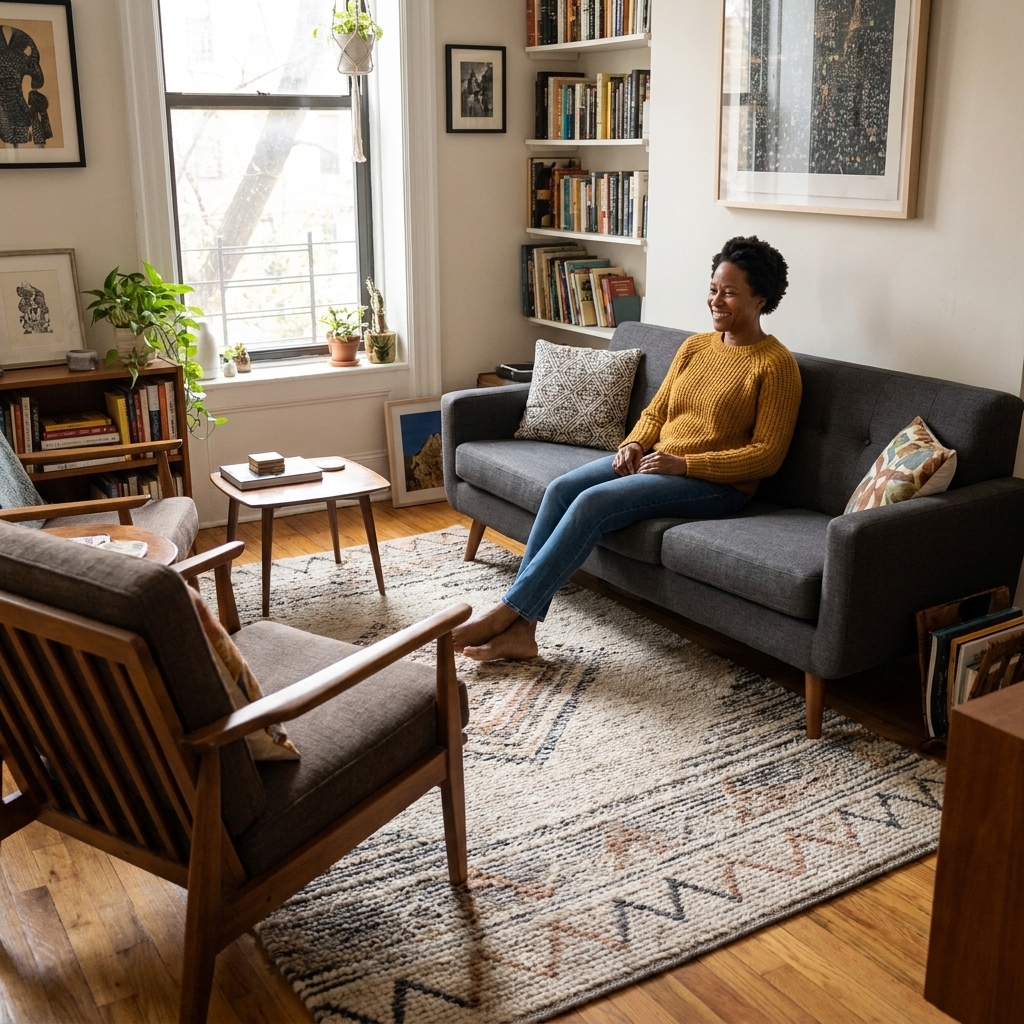
Living room: front legs on
- Best: All furniture legs on the rug. This is the most expansive, most cohesive look.
- Great (and common in apartments): Front legs of the sofa and chairs on the rug, back legs off. It still reads like one zone.
- Avoid: Only the coffee table on the rug. This is the classic floating island that makes the room feel choppy.
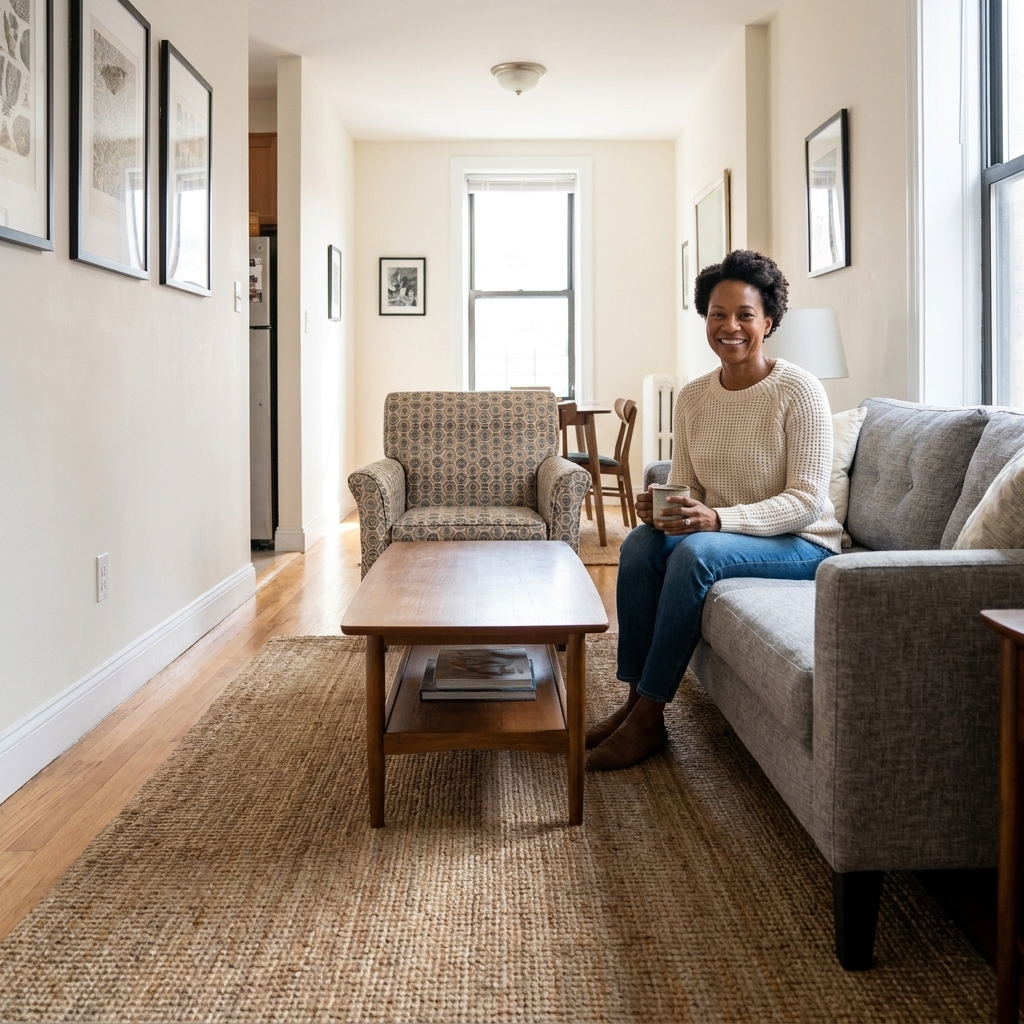
Quick size guide: In many small living rooms, an 8x10 is the sweet spot even when it sounds huge. In tighter layouts, a 6x9 can work if it still reaches under the sofa and chair front legs. If you are stuck choosing between the two, prioritize the size that lets the rug extend at least a few inches past each end of the sofa.
Bedroom: soft landing
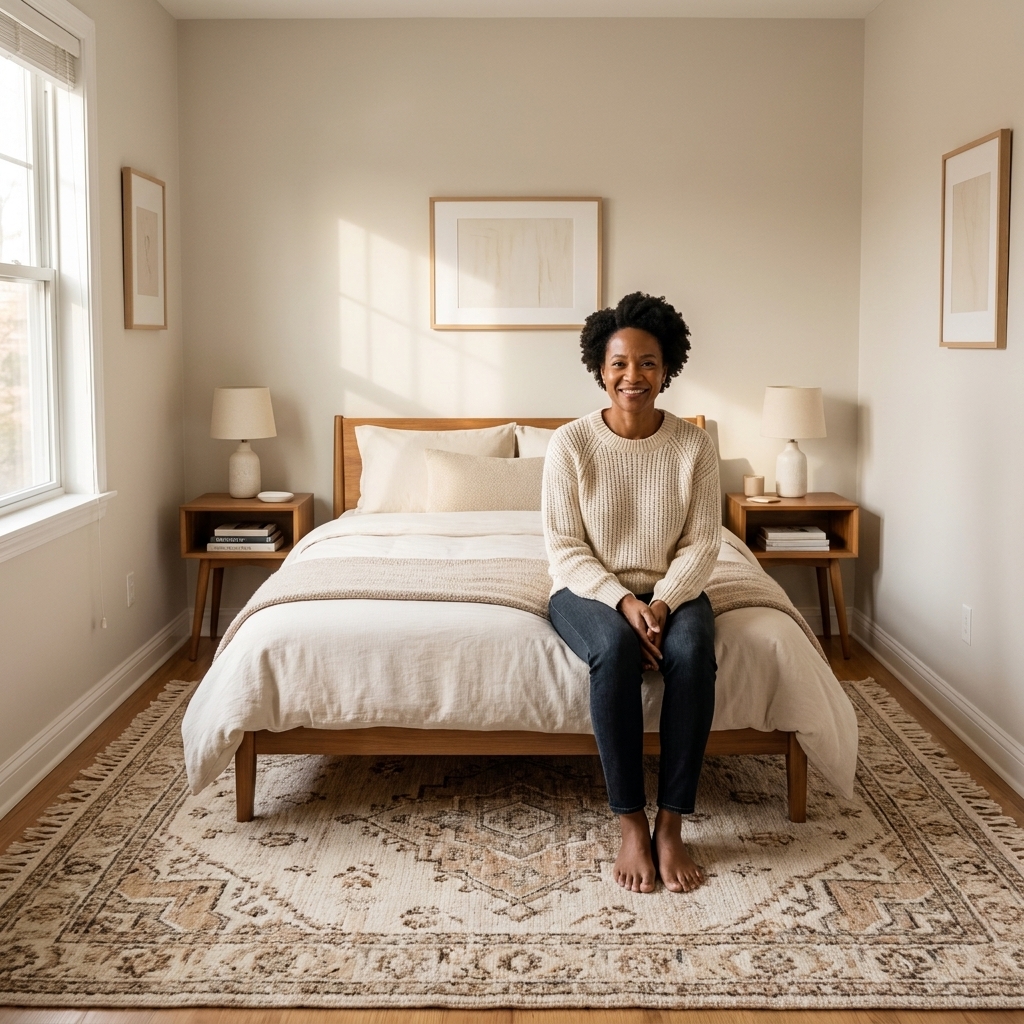
Your feet should hit rug when you get out of bed. In a small bedroom, that usually means:
- Best: An area rug placed under the bed so it extends on both sides and the foot of the bed.
- Alternative: Two runners on either side of the bed (helpful for super tight rooms, radiators, or tricky door swings).
Quick size guide: For a full or queen bed, an 8x10 often looks surprisingly right if the room allows it. In very tight bedrooms, a 6x9 is sometimes the practical ceiling, and a 5x8 can be the better fit for a full if you are working around a closet door or a narrow walkway. Choose the biggest size that still lets doors open cleanly and keeps your main path clear.
Dining area: chairs stay on
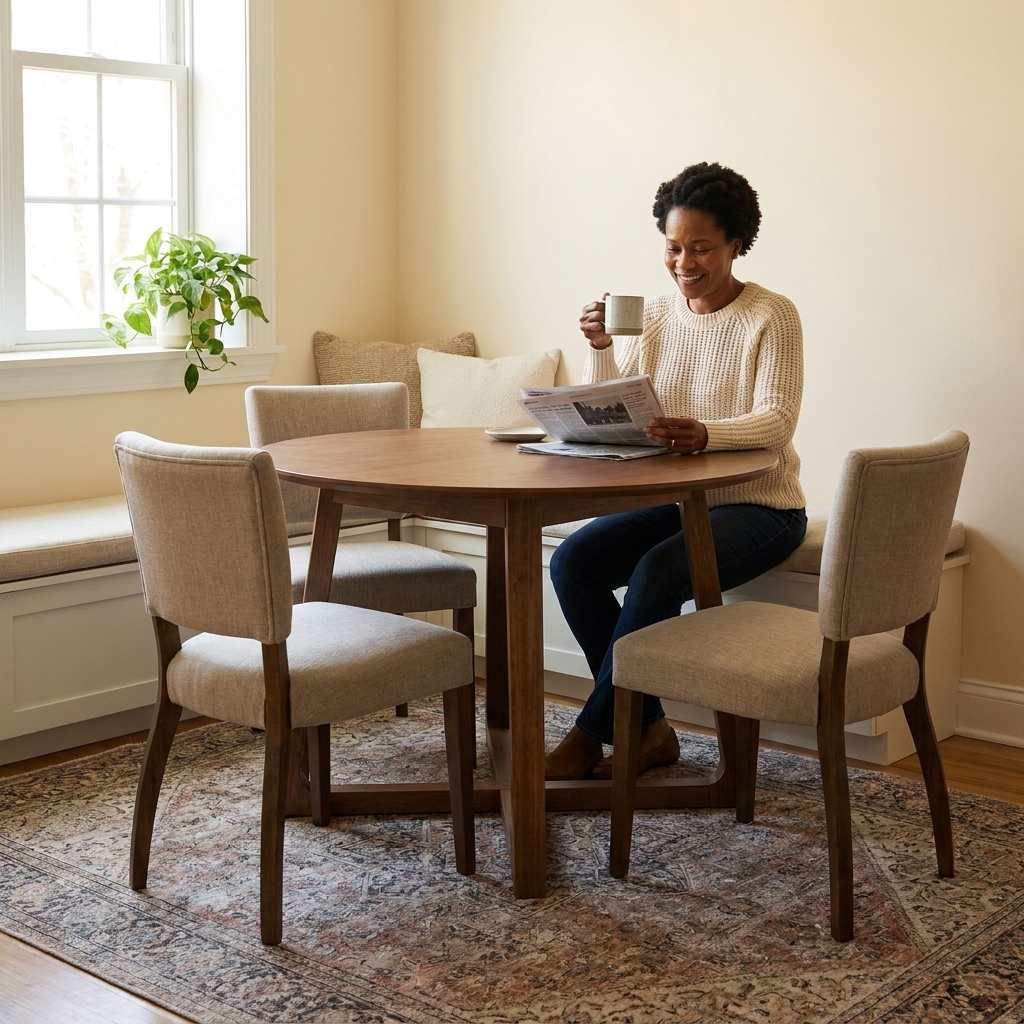
If you have ever heard chair legs scraping on and off a rug edge during dinner, you already know this one.
- Choose a rug that extends 24 to 30 inches beyond the table on all sides, so chairs remain on the rug when pulled out.
- In tight eat-in kitchens, consider a low-pile or flatweave rug so chairs slide more easily.
How to place a big rug
Buying the right size is half the magic. Placement is the other half.
1) Give the rug one job
In small homes, rugs should define a zone. Ask: is this rug anchoring the seating area, the bed, or the dining set? One rug, one job.
2) Keep a border, but do not stress it
You will hear “leave 8 to 12 inches of bare floor around the rug.” That can be a helpful goal, not a universal rule. In rentals with weird dimensions, I prioritize these in order:
- front legs of key furniture on the rug
- rug centered on the main focal point (sofa wall, bed wall, TV wall)
- comfortable walkway clearance
If that means you only have 3 to 6 inches of border on one side, it is still often better than downsizing the rug.
3) Center on the furniture, not the room
This is the counterintuitive part. If your sofa is shifted because of a radiator, a door swing, or an awkward nook, the rug should follow the seating area, not the room’s mathematical center.
4) In long rooms, run it long
Let the rug echo the room’s shape. A rug turned the wrong direction can make a narrow room feel even more corridor-like.
Material, pile, and pad basics
Size gets the credit, but texture and thickness are what make a rug livable in a small apartment.
- Go lower pile in high-traffic layouts. If you have doors that skim the floor or dining chairs that scrape, a low-pile or flatweave rug is usually the least annoying choice.
- Use a rug pad. On hard floors, a non-slip pad helps prevent sliding, protects rental flooring, and makes even a budget rug feel thicker. If door clearance is tight, choose a thinner pad.
- Think about your real life. Washable rugs are a sanity saver with pets, kids, or red wine friends. Natural fiber rugs (like jute) can look great for the price, but they can shed and feel rough under bare feet.
Tiny-apartment cheat sheet
- If you are between sizes, go up. A slightly-too-big rug often looks more intentional than a too-small rug, as long as doors and walkways still work.
- Measure with painter’s tape. Tape the rug outline on the floor, then open drawers and doors. Live with it for a day.
- Watch for door clearance. If a bedroom door catches the rug, switch to a lower pile, a thinner pad, or adjust placement so the door swings over bare floor.
- Layer if you must. If you already own a small rug you love, layer it on top of a larger, budget-friendly natural fiber rug to get the big-rug footprint.
- Choose calmer patterns for expansion. Big, high-contrast patterns can feel busy in small rooms. Subtle texture, tone-on-tone, or low-contrast geometrics tend to stretch space visually.
- Expect sizing labels to be approximate. A rug sold as “6x9” may be a few inches off in either direction, so always check the actual dimensions before you order.
Common mistakes
Mistake: It is floating in the middle
Fix: Slide the rug under the sofa so at least the front legs are on it. Yes, even if it looks “too big” at first. Give it a day and see how the room feels.
Mistake: Only the coffee table fits
Fix: Either size up, or rotate the rug if the dimensions allow. In small rooms, orientation can be the difference between postage stamp and purposeful zone.
Mistake: It stops exactly at the sofa edge
Fix: Let the rug extend past the sofa on both sides if possible, even if it is just 4 to 8 inches. That little overhang reads as intentional.
Mistake: It fights the walkway
Fix: Shift the rug and furniture together to preserve a clean path. A rug should make a room easier to move through, not harder.
Budget ways to go bigger
Big rugs cost more, but you have options that do not require a design-show budget.
- Shop used. Facebook Marketplace and local resale shops are gold mines for 8x10s.
- Choose solids or simple weaves. You typically get more square footage per dollar with jute-look, flatweave, or low-pile basics.
- Try a large neutral base and layer a smaller statement rug. The base does the space-expanding work. The top rug brings personality.
- Do not skip the pad. It helps prevent slipping and keeps edges from curling, which matters a lot in high-traffic small apartments.
Quick FAQ
Can a rug be too big for a small room?
Yes. If the rug forces doors to stick, creates a tripping edge, covers a floor vent you need, or swallows necessary walkway space, it is too big. Otherwise, big is often exactly what makes a small room feel more open.
Should I leave space between the rug and the wall?
Ideally, yes. A small border of visible floor helps frame the rug. But if your choice is perfect border with a tiny rug versus slightly tight border with correct furniture placement, choose correct furniture placement.
What if my sofa is against the wall?
Totally fine. Pull the rug under the sofa’s front legs and let it extend into the room. The rug does not need to go all the way to the wall to work.
Do light rugs make a room look bigger?
Often, yes. Lighter tones reflect more light and feel airier. That said, the size and placement matter more than color. A correctly sized darker rug can still expand the room more than a tiny light one.
The takeaway
If your room feels choppy, cramped, or like your furniture is awkwardly hovering, do not buy smaller accessories to compensate. Go the other direction. A bigger rug is one of the simplest ways to make a small space feel grounded, cohesive, and quietly larger.
And if you want permission from your friendly neighborhood Tetris master: yes, your small room can often handle an 8x10. If it cannot, the biggest size that gets those front legs on still counts.