Seven renter-friendly lighting moves that visually lift your ceiling, brighten dark corners, and make a small apartment feel more open.
Space Ovo
Mirror Placement for Tiny Studios
Use mirrors to bounce light, fake depth, and make a small studio feel bigger. Learn the best placements, angles, heights, and renter-friendly hanging tips.

Maya Brooks
Maya Brooks is an interior stylist and layout enthusiast who believes square footage should never dictate your home's style. After a decade of navigating cramped city studios, she shares practical, renter-friendly decorating and storage solutions to help others maximize their tiny spaces.
Created October 17, 2026
Updated October 17, 2026
If you have ever stood in your studio holding a mirror like a steering wheel, slowly turning it left and right hoping your room magically grows, welcome. Mirrors are one of the fastest ways to make a tiny space feel bigger, but only when they reflect the right thing. The goal is not “add mirror.” The goal is “add believable depth and better light.”
Below is my renter-friendly, measuring tape always nearby guide to placing mirrors opposite windows and light sources so your studio feels brighter, airier, and yes, bigger.
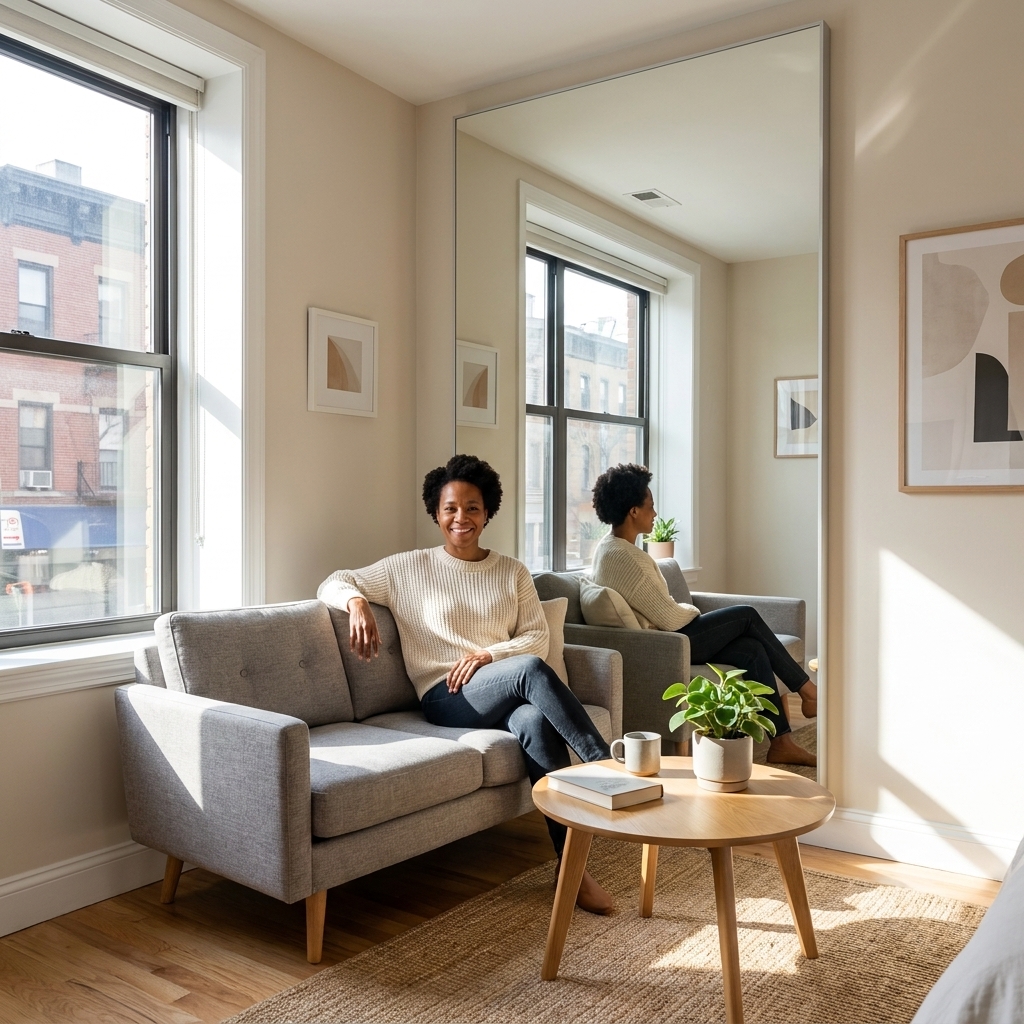
The mirror rule that changes everything
Here is the rule I follow in every cramped apartment: A mirror is only as good as what it reflects. If it reflects light, greenery, open space, or a calm vignette, it expands your room. If it reflects a clutter pile, a messy kitchen corner, or your laundry chair, it expands the chaos.
Before you hang anything, do this quick “reflection audit”:
- Stand where you spend time (sofa, bed, desk).
- Hold the mirror up or tape paper the same size to the wall.
- Look at the reflection, not the mirror. Ask: would I want to see this twice?
Best placement: opposite a window
Placing a mirror opposite a window is the classic tiny-space move because it bounces daylight back into the room and can create a “second window” effect. The trick is to match the placement to what you want the room to feel like.
Option A: Mirror directly opposite the window
What it does: amplifies natural light and creates that “second window” illusion.
Works best when: the window has a pleasant view (sky, trees, even an attractive building facade) or at least clean daylight.
How to place it:
- Center the mirror so the window reflection feels intentional, not accidental.
- Aim for the mirror to reflect as much of the window as possible without showing the window frame crooked. Slightly off-center is often better than “perfectly” centered if your window is off to one side.
- If your studio is very narrow, go bigger than you think. A full-length mirror or a large vertical rectangle reads like added architecture.
Glare check: If you get strong afternoon sun (west-facing) or intense midday light (often south-facing), sit where you actually sit and look for hot spots. If the mirror throws glare at your sofa or desk, shift it a few inches, angle it slightly, or add sheer curtains to soften the bounce.
Option B: Mirror on the wall perpendicular to the window
What it does: bounces light deeper into the room and reduces harsh contrast (bright window, dark interior).
Works best when: your window faces an alley or you do not want to spotlight the view.
How to place it: hang it so it catches the window light at an angle and throws it across the main living zone. This is especially helpful when your bed is far from the window and everything feels dim by 3 pm.
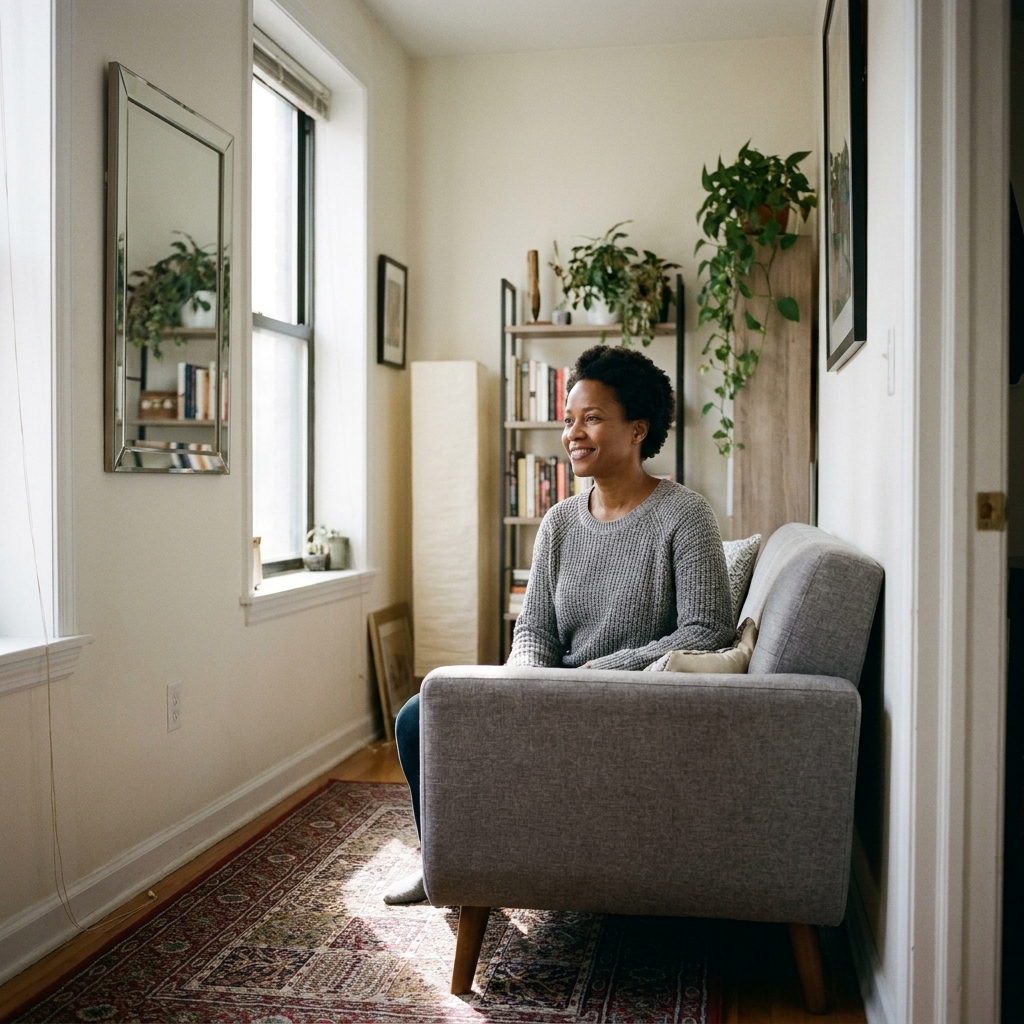
How to angle mirrors for depth
Most people hang mirrors flat and call it a day. In tiny spaces, a slight angle can do more than size. It can redirect light and control what the mirror repeats.
Use a leaning mirror for flexible angles
A leaning floor mirror is my favorite renter trick because you can micro-adjust it without drilling a new hole.
- Angle it slightly toward the window to capture more daylight.
- Angle it slightly away from clutter zones (entry drop zone, kitchen counter, laundry basket corner).
- For safety, secure the top with furniture anti-tip straps. If you use removable mounting strips, follow the manufacturer’s instructions and use them only if they are truly rated for your mirror, your wall surface, and your paint condition.
- Make sure the mirror is fully supported by the floor (not perched on baseboards) and avoid setting it on thick plush rugs that can make it wobble.
For wall mirrors, “cheat” the angle with hardware
If your mirror hangs from a wire, you can adjust its tilt by adding small felt pads or rubber bumpers behind the bottom corners. This changes the reflection without making the mirror look crooked from the front.
Tetris master tip: you are not aiming for a dramatic tilt. Think subtle, like the mirror is gently “looking” toward the light source.
Where mirrors work hardest
Studios are tricky because everything is everything. Your living room is your bedroom is your dining room. These placements create the most convincing illusion of more space.
1) Across from the main seating area
When you sit, you see depth. A mirror across from your sofa or lounge chair makes the room feel like it continues.
- A common starting point is “gallery height,” with the mirror’s center around 57 inches from the floor, then adjust for your sightline.
- If you spend more time seated (hello, Netflix), drop it a bit so the reflection is enjoyable from the sofa.
2) Behind the sofa (only if it reflects something pretty)
Behind-sofa mirrors can be gorgeous, but only when they reflect light or a styled wall. If your sofa faces the kitchen chaos, skip it.
Instead, place a mirror behind the sofa when it will reflect:
- a window
- a calm wall with art
- a plant corner
3) The entry zone to stop the “hallway shrink”
If your studio entry feels like a tunnel, a mirror can stop that compressed feeling immediately.
- Place it on the wall you see first when you walk in.
- If possible, position it to catch daylight from the main window so your entry does not feel like a cave.
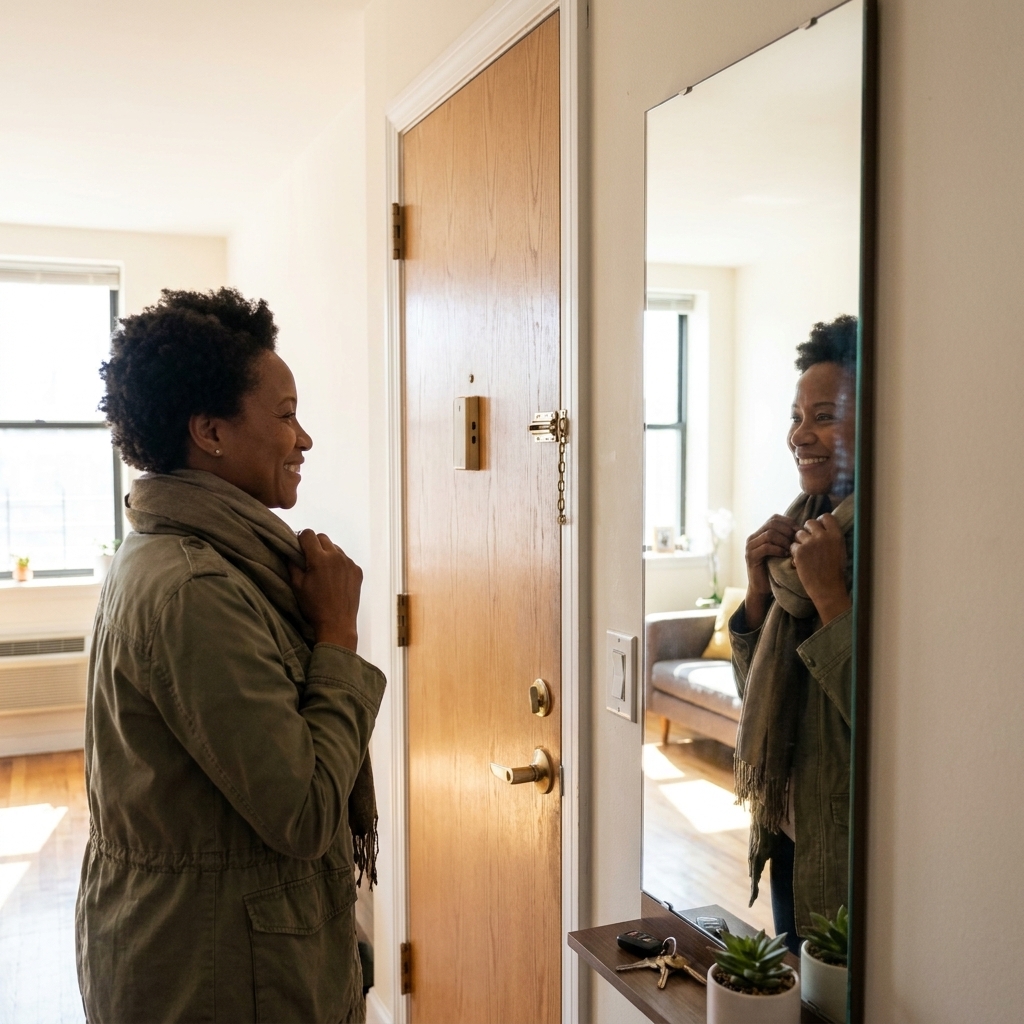
Mirror sizes and shapes
In small spaces, mirrors are visual architecture. Size and shape change the vibe fast.
Go larger than your instincts
A tiny mirror is cute, but it does not shift the room’s perceived boundaries. If you want the “double the space” illusion, choose one of these:
- Full-length mirror (best for studios, adds height and depth)
- Large rectangle (reads like a window, very believable)
- Oversized round (softens boxy rooms, great above a small dining table)
Match shape to what your studio needs
- Vertical mirrors make ceilings feel taller. Perfect when your studio feels squat.
- Horizontal mirrors make walls feel wider. Great in narrow layouts.
- Arched mirrors add a “built-in” feel and create instant charm without adding furniture.
What to reflect (and avoid)
Reflect these for a “bigger room” effect
- Windows and daylight
- Lamps with warm bulbs (generally 2700K to 3000K feels cozy in most homes)
- Plants or greenery
- Open floor or a clean rug area
- A styled vignette like a small shelf, art wall, or tidy bar cart
Avoid reflecting these (unless you love chaos twice)
- Overflowing kitchen counters
- Laundry baskets
- Busy cable zones and router clutter
- Storage piles, open bins, unmade bed
- Harsh ceiling fixtures that glare in the mirror
If your only possible reflection is messy, flip the strategy: use the mirror to reflect a calmer direction by angling it slightly, or relocate it to a different wall.
Also, a small thing that makes a big difference: keep the mirror clean. Smudges and dust mute the light-bounce effect.
Mirrors with lamps at night
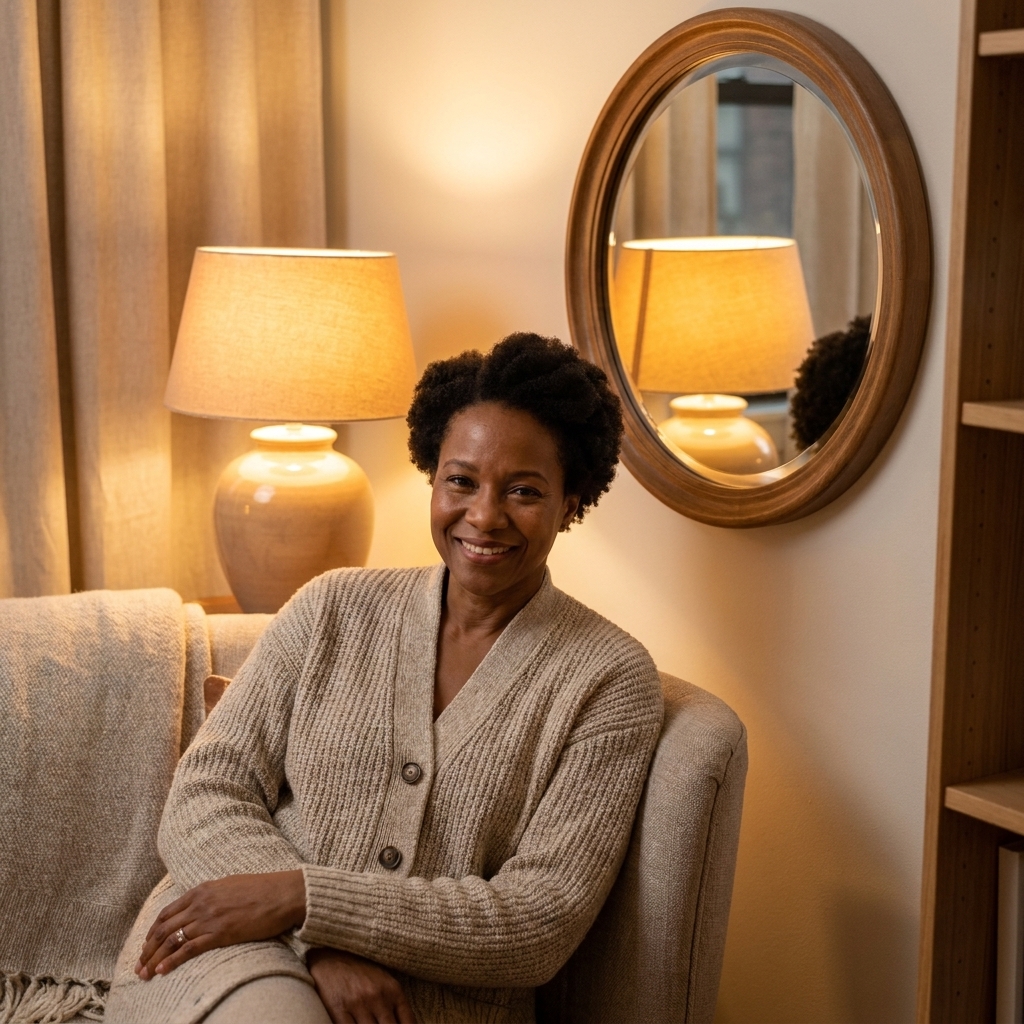
Opposite windows is the daytime win. At night, mirrors can make your lighting feel more layered and expensive, even if every lamp is from a big box store.
Place a mirror behind a lamp
Put a table lamp in front of a wall mirror or place a mirror on the wall behind a console with a lamp. The mirror doubles the glow and makes the corner feel deeper.
Use two light sources, one mirror
If you have one floor lamp and one table lamp, try positioning the mirror so it reflects the second lamp. It reads like you have more lighting than you actually do, which makes the whole studio feel larger and more intentional.
Renter-friendly hanging tips
I love a dramatic mirror moment, but I love a deposit refund more. Use the method that matches your mirror’s weight and your wall type.
Lightweight mirrors
- Removable hanging strips rated for the mirror’s weight and approved for your wall surface
- Removable hooks rated for frames
- Picture rail hooks if your building has rails
Heavier mirrors
- Anchor into studs when possible
- If you must use drywall anchors, choose the correct weight rating and hardware type
- Skip removable strips for heavy glass mirrors unless the manufacturer explicitly says they are suitable for that weight and your wall condition
- For leaning mirrors, secure with anti-tip straps
Safety note: If you live in an older building with questionable walls, a leaning mirror secured at the top is often safer than trusting old drywall with a heavy frame.
Quick mirror placement recipes
If you want the fast version, here are my go-to setups for common studio problems.
Problem: The room feels dark
- Place a large mirror opposite the window, or perpendicular to it if the view is ugly.
- Add one warm lamp and let the mirror reflect it at night.
Problem: The studio feels narrow
- Hang a horizontal mirror on the long wall.
- Angle it to reflect open floor, not furniture bulk.
Problem: The bed area feels cramped
- Use a full-length mirror near the bed, but do not aim it directly at the pillow zone if that bothers you.
- Instead, angle it to reflect the window or a plant.
Problem: The entry feels like a closet
- Add a slim mirror near the door.
- Make sure it catches light from the main room.
Common mistakes (I have made all of these)
- Too small: Tiny mirrors read like decor, not depth.
- Reflecting clutter: The mirror is innocent. It is just reporting back.
- Too high: If you only see ceiling in the reflection, you lose the space-expanding effect.
- Glare city: Mirrors directly reflecting bare bulbs can feel harsh. Use shades or warmer bulbs.
- Over-mirroring: One or two well-placed mirrors usually beats four random ones. Your studio should feel calm, not like a funhouse.
FAQ
Do mirrors really make a studio look bigger?
Yes, when they reflect light and create a believable continuation of space. The most dramatic results come from large mirrors placed opposite or adjacent to a window.
Is it better to place a mirror opposite a window or next to it?
Opposite is best for maximum brightness and a “second window” illusion. Next to the window is best when you want to bounce light deeper into the room without highlighting the view.
How high should I hang a mirror in a small apartment?
A common starting point is “gallery height,” with the mirror’s center around 57 inches from the floor. Then adjust based on whether you want it to look best from standing height or seated height.
What kind of mirror is best for a tiny studio?
A full-length mirror or a large rectangular mirror usually creates the most convincing expansion effect. If your studio is very boxy, an arched mirror softens the lines beautifully.
Your 10-minute mirror test
If you do nothing else, do this today:
- Take your largest mirror.
- Move it to face your main window, then move it to a perpendicular wall.
- Stand in your usual spot and compare how the room feels.
- Choose the placement where the mirror reflects light plus calm.
Your studio does not need more square footage to feel breathable. It just needs better sightlines, better bounce, and a mirror that knows what it is doing.